Four Searches, Twenty Minutes: How to Verify a Colombian Surgeon Before You Book
Colombia's best surgeons and dentists are among the finest in the hemisphere — and confirming that you've found one takes about twenty minutes and four free public databases.
Here's how.
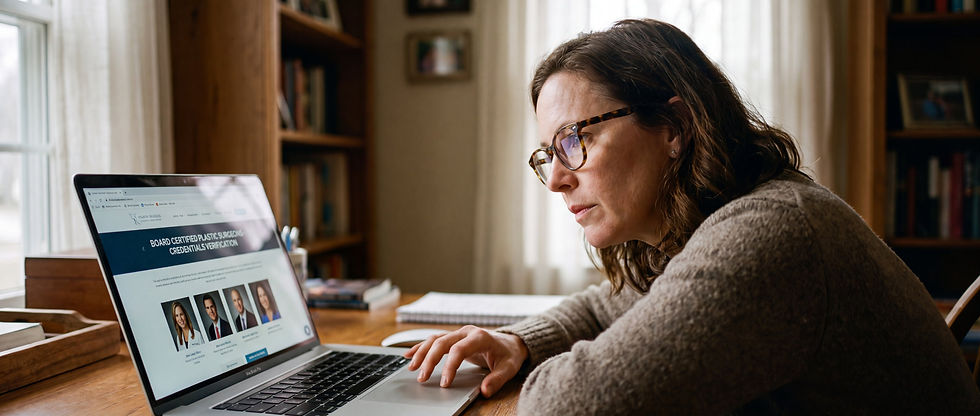
You have two quotes, three names, and a browser tab open to somebody's Instagram. The photographs are beautiful. The prices are a third of what you were quoted at home. Everyone in the comments is delighted.
None of that is evidence.
Here is what almost no one traveling to Colombia for surgery knows: the Colombian government maintains free, public databases that will tell you, in minutes, whether the person you're considering is a licensed physician, whether they actually hold the surgical specialty they claim, whether anyone has ever disciplined them, and whether the building where your surgery would happen is licensed to perform it. No Spanish fluency required beyond a translated browser tab. No appointment, no fee, no permission from anyone.
Colombian patients use these tools. Foreign patients almost never do — which is precisely backwards, since the foreign patient is the one who can't ask her cousin which surgeon is the real one.
This is how to run the check.
Where the risk actually sits
Before the how, the why — because the risk in Colombian aesthetic medicine is badly misunderstood abroad. It is not spread evenly across the profession. It concentrates almost entirely in one place: unlicensed venues staffed by people who are not surgical specialists.
Bogotá's health secretariat identified at least 194 sites performing aesthetic surgery without authorization between January 2025 and May 2026. Medellín has recorded seventeen deaths in two years connected to what the Colombian press calls "garage clinics," though the trend is downward — eleven in 2024, five in 2025, one so far this year. Forensic investigators estimate that Colombia's major capitals average between five and twelve deaths a year tied to procedures performed in unauthorized operating rooms or by people posing as surgeons. Liposuction and fat transfer carry the highest mortality in these settings, typically through pulmonary embolism, necrotizing infection, or the injection of biopolymers — a substance Colombian law has prohibited for aesthetic use since 2023.
Notice what those cases have in common. Not "surgery in Colombia." Not even "inexpensive surgery in Colombia." They trace back to a venue that wasn't licensed, a practitioner who wasn't a specialist, or a substance that wasn't legal — and all three are checkable before you book.
A plastic surgeon in Bogotá explained the physical logic to the Colombian press: the problem with an informal clinic isn't only technique. It's that if something goes wrong, the building has no capacity to respond. No crash team down the hall, no ICU upstairs. That is the difference the four checks below are really measuring.
Check one: Is this person legally allowed to practice medicine at all?
Colombia maintains a national registry of everyone authorized to work in health care, called ReTHUS — the Registro Único Nacional del Talento Humano en Salud. It's administered by the Ministry of Health under a 2007 law, and it exists precisely so that citizens can confirm a practitioner has met the legal requirements to practice. Crucially, it also records ethical and disciplinary sanctions handed down by the health sector's tribunals.
You search it free, through the Ministry's SISPRO portal, with four pieces of information: document type, document number, first name, and first surname. Ask your prospective surgeon for their cédula number. A legitimate one will give it to you without hesitation — it appears on their diploma, their office wall, and every prescription they write.
What you're looking for: an active registration, and a registered specialty. This is the part patients miss. Someone can appear in ReTHUS as a perfectly legal médico general — a general physician — and have no surgical specialty whatsoever. That person is not a criminal. They are simply not a plastic surgeon, no matter what their Instagram bio says. For plastic surgery, the specialty should appear under its official name: Cirugía Plástica, Estética y Reconstructiva.
If the name doesn't appear at all, stop. If it appears without the specialty, stop.
Check two: Is the specialty real, and current?
ReTHUS tells you the state's position. The Sociedad Colombiana de Cirugía Plástica, Estética y Reconstructiva (SCCP) tells you the profession's. Founded in 1956, it is one of the oldest surgical societies in the Americas and admits only surgeons who completed formal, university-backed training in the specialty — roughly 850 certified members.
Its member directory is public and searchable by city, and every city SANSAVI covers is in it: Pereira, Armenia, Manizales, Medellín, Cali, Bogotá.
What you're looking for: the status Miembro Activo. Categories like aspirante or miembro pasivo are not the same thing, and a surgeon who describes themselves loosely as "SCCP" while sitting in one of those categories is telling you something. Watch, too, for near-miss spellings — a name that is almost the one you were given is a well-worn trick.
A surgeon who clears both ReTHUS and the SCCP directory has satisfied the two independent authorities that matter. One is the government; the other is their own peers. Fraud requires fooling both.
Check three: Is the building licensed for what will happen inside it?
This is the check almost nobody runs, and it may be the one that matters most — because the surgeon can be immaculate and the room can still kill you.
Every health provider in Colombia, whether an institution or an independent professional, must be entered in the REPS — the Registro Especial de Prestadores de Servicios de Salud — with at least one physical location and at least one habilitated service. It's the Ministry's database, it's public, and you can search it by provider, by location, and by the specific service authorized at that address.
Two distinctions worth carrying with you:
Habilitación is the floor, not the ceiling. It's the mandatory minimum license to operate. It is not a mark of excellence.
Acreditación is the ceiling. It's voluntary, demanding, and rare — as of December 2024, only 61 institutions in the entire country held current accreditation, against tens of thousands of merely habilitated ones. If a clinic has it, that's a genuine signal.
What you're looking for: the clinic's name in REPS, at the specific address where your surgery will occur, with surgery among its habilitated services. A group can be perfectly legitimate at its main hospital and be operating a satellite consultation office that is licensed for consultations only. You want to know which building you'll be unconscious in. Colombian law also requires providers to display their habilitation certificate visibly at each location — when you arrive, look for it.
Check four: What happens if something goes wrong?
Ask, out loud, in the consultation, and listen for specifics rather than reassurance:
Which hospital will the surgery take place in, and does it have an ICU on site?
Who is the anesthesiologist, and are they a registered specialist? (Run them through ReTHUS too. It takes ninety seconds.)
How many nights of monitored recovery are included, and where?
If a complication develops after I fly home, what is the protocol — and who pays?
What exactly does the quoted price include: surgical fee, anesthesia, facility, garments, follow-ups, medications?
And one absolute: no biopolymers, ever. Colombia banned them for aesthetic purposes under Ley 2316 of 2023. Be alert to rebranding — Colombia's health superintendency has been investigating clinics, including some marketing to foreign patients, over procedures sold as "stem cell" treatments that were allegedly biopolymer injections.
A note for dental patients
The same architecture applies. Dentists appear in ReTHUS, and so do their postgraduate specialties, which they are required to register. The gap to watch for is the one between a specialty and a course: implantology and other high-value dental work are sometimes advertised on the strength of a short certificate rather than a formal postgraduate degree. Ask which it is, and check what ReTHUS actually shows. And apply the REPS check to the dental clinic exactly as you would to a surgical one.
The red flags, in one list
A price quoted before anyone has examined you
Pressure to pay a deposit to "hold" a surgery date
WhatsApp as the only channel; no fixed clinic address
A "coordinator" or "patient advisor" who won't name the surgeon
Before-and-after photos with no surgeon's name attached
Surgery offered in a spa, a salon, an apartment, or a "medical suite" you can't find in REPS
Anyone who reacts badly to being asked for their cédula number
That last one is the most useful diagnostic in this article. A certified surgeon has been asked before and expects it. Only one type of practitioner is offended by verification.
The honest conclusion
Roughly twenty minutes, four free searches, no Spanish fluency required beyond a translated browser tab. That's the whole cost of the difference between choosing a surgeon and choosing an advertisement.
Colombia's best specialists are, by any international measure, excellent — and they are the ones who will hand you their credentials before you ask. This magazine exists to find them for you. But the checks above are yours to run, on any name, from anywhere, including the ones you find in these pages.
SANSAVI is an independent editorial publication. We are not a healthcare provider, agency or booking service, and nothing here is medical advice. Always confirm a specialist's credentials directly and consult a qualified physician before any procedure.

Comments