Clear Aligners in Colombia: Why International Patients Are Choosing Invisible Orthodontics
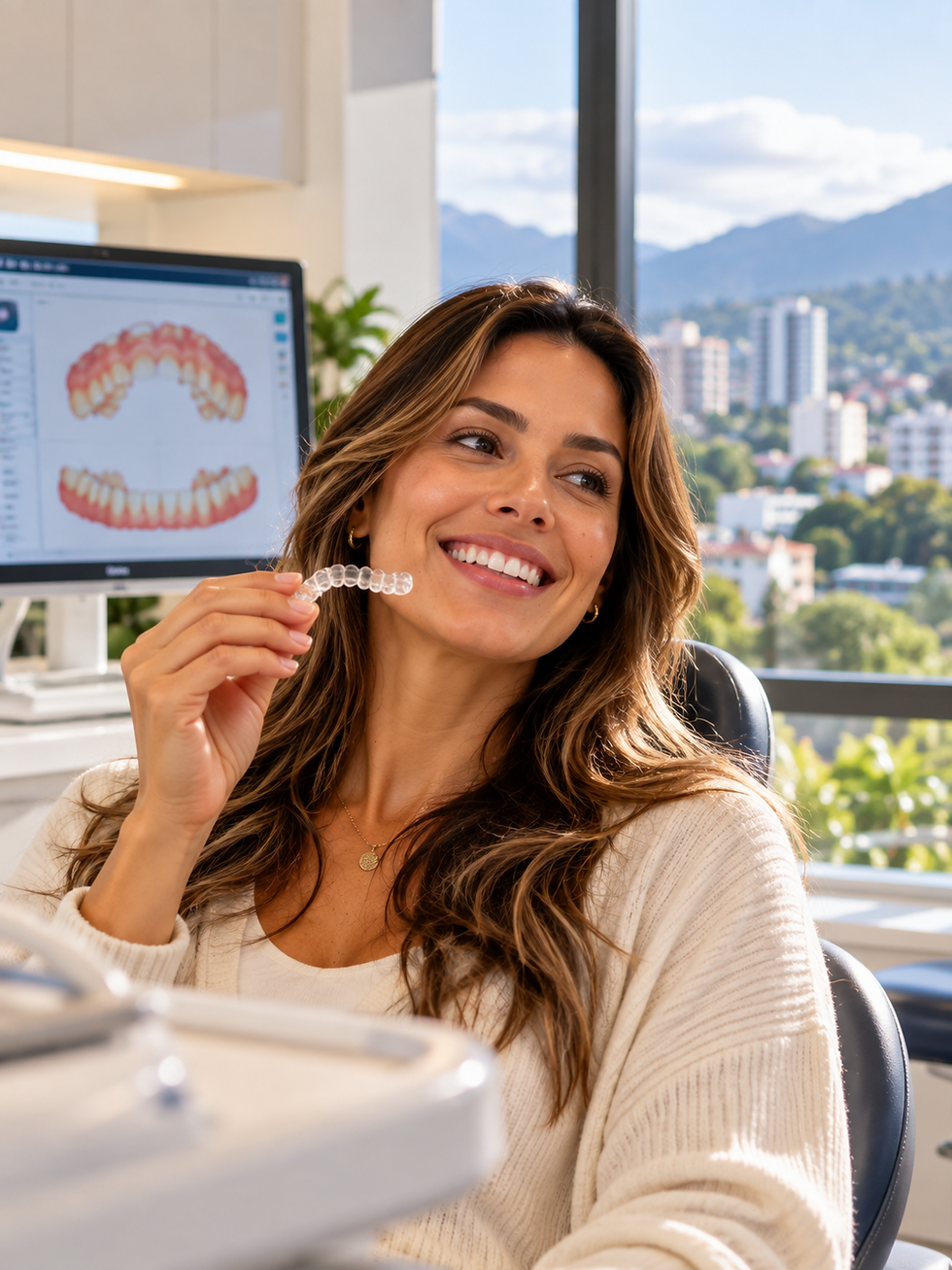
A smarter way to transform your smile when you don't live in Colombia
For many international patients, getting orthodontic treatment abroad may sound complicated.
How many appointments will I need?Will I have to stay in Colombia for months?What happens if I return home and need a follow-up?Can my orthodontist monitor my treatment remotely?
These are reasonable questions.
And they explain why clear aligner treatment has become particularly interesting for international patients looking for orthodontic care in Colombia.
Unlike traditional braces, clear aligners are removable, discreet and digitally planned. When combined with appropriate remote monitoring, they can also reduce the number of appointments that require you to physically return to the clinic.
For someone traveling from the United States, Canada, Europe or another Latin American country, that can make a significant difference.
But the real advantage isn't simply convenience.
It is the combination of digital orthodontics, specialist care, discreet treatment and the possibility of continuing follow-up after you return home.
Why are international patients looking at Colombia for orthodontic treatment?
Colombia has developed an increasingly international healthcare and medical tourism sector, with dentistry among the services offered to international patients.
ProColombia has identified qualified healthcare professionals, technology, personalized attention and competitive costs among factors that have contributed to Colombia's appeal as a healthcare destination.
For international patients, however, choosing a country is only the first step.
The more important question is:
Can the treatment be organized around my life and travel schedule?
This is where clear aligners can become particularly attractive.
What are clear aligners?
Clear aligners are transparent, removable orthodontic trays designed to gradually move teeth according to an individualized treatment plan.
Instead of using brackets and wires, the orthodontist creates a digital treatment plan and a sequence of aligners designed to progressively move the teeth.
The treatment can involve:
Digital scan → treatment planning → customized aligners → scheduled changes → clinical monitoring → refinement when necessary → retention
The exact sequence varies according to the patient's diagnosis and treatment plan.
Digital orthodontics has also changed how orthodontists can visualize and plan treatment. Research supports the use of virtual orthodontic setups, although predicted tooth movement should always be understood as a clinical planning tool rather than a guarantee of the final result.
Why are clear aligners especially interesting for international patients?
Imagine a patient who lives in Miami but wants orthodontic treatment in Pereira.
With traditional orthodontic treatment, frequent in-person appointments can become difficult.
With clear aligners, the orthodontist may be able to structure part of the treatment around digital communication and remote monitoring, depending on the complexity of the case and the clinical protocol.
This doesn't eliminate the need for professional supervision.
Instead, it can reduce the number of times a patient needs to physically visit the clinic.
A systematic review of dental monitoring found that remote monitoring incorporated into orthodontic care can significantly reduce the number of in-office visits. Across the studies analyzed, reductions ranged from approximately 1.68 to 3.5 visits. However, the evidence did not consistently show that remote monitoring shortened the total treatment duration.
That distinction matters.
Fewer trips to the clinic does not necessarily mean faster orthodontic treatment.
It can mean a more flexible treatment experience.
The biggest advantage: fewer in-person appointments
For someone living abroad, every orthodontic appointment has a cost beyond the dental visit itself.
There may be:
Flights
Hotels
Time away from work
Transportation
Scheduling challenges
Family commitments
Visa or travel considerations
Reducing unnecessary in-person visits can therefore make treatment significantly easier to manage.
One clinical study involving Invisalign patients found that those receiving remote dental monitoring had 3.5 fewer appointments, representing a 33.1% reduction, compared with the control group. The same study found a shorter time to the first refinement.
Other research has found similar reductions in appointment burden, although results vary depending on the monitoring system, provider and treatment protocol.
For an international patient, that difference can be meaningful.
Can orthodontic treatment be monitored virtually?
In many cases, yes — but virtual monitoring should complement, not replace, professional orthodontic care.
Digital monitoring systems can allow patients to submit photographs or scans of their teeth from their smartphone so that the orthodontic team can evaluate treatment progress between appointments.
Research has specifically investigated remote monitoring during clear aligner therapy and found that digital monitoring can support treatment follow-up and reduce the number of traditional appointments.
However, technology has limitations.
A 2023 prospective study evaluating AI-assisted remote monitoring found concerns regarding the consistency of some automated treatment-progress instructions. This reinforces an important principle:
Artificial intelligence can support orthodontic monitoring, but it should not replace clinical judgment.
For an international patient, this means the ideal model is not:
“No more dentist visits.”
It is:
“The right in-person visits, supported by digital monitoring between them.”
What about seeing results quickly?
This is one of the biggest reasons people are interested in clear aligners.
Because the treatment is digitally planned, patients can often see a simulation of the proposed tooth movements before treatment begins.
That can make the treatment process easier to understand.
But there is an important distinction between seeing a digital projection and achieving the final clinical result.
A virtual treatment plan is a simulation based on the orthodontist's diagnosis and the expected response of the teeth. Actual tooth movement can differ, and some patients require additional aligners or refinement stages.
A 2026 systematic review found that refinement after an initial series of clear aligners is influenced by factors such as the complexity of the malocclusion and the type of tooth movement required.
So while clear aligners can offer a highly visual treatment experience, no responsible orthodontist should guarantee a specific final result or treatment duration before evaluating the individual case.
How long does clear aligner treatment take?
There is no single answer.
Treatment time depends on:
The patient's starting condition
The type of tooth movement required
The complexity of the case
The number of aligners
Patient compliance
Whether refinement is required
The orthodontist's treatment plan
Some relatively straightforward cases can progress more quickly than complex orthodontic problems.
This is why international patients should be cautious with websites promising:
“Perfect teeth in three months.”
A better question is:
“What is the estimated treatment time for my specific diagnosis?”
A qualified orthodontist can provide a much more meaningful answer after examining the patient and reviewing the necessary diagnostic information.
The international patient advantage
For someone traveling to Colombia specifically for orthodontic treatment, the treatment model can be divided into stages.
Before traveling
The patient can communicate with the clinic, provide relevant medical and dental information, and discuss treatment objectives.
Depending on the clinic's protocols, a preliminary virtual consultation may help determine whether an in-person evaluation is appropriate.
During the visit to Colombia
The orthodontist performs the necessary clinical evaluation and diagnostic records.
Digital scanning and treatment planning can then be incorporated into the process where clinically appropriate.
After returning home
The patient continues following the orthodontist's instructions and, where the treatment protocol allows, uses digital monitoring for progress checks between in-person appointments.
During future visits to Colombia
The orthodontist evaluates progress, makes any necessary clinical adjustments and determines whether the patient should continue, modify or refine the treatment plan.
The exact protocol varies from one clinic and patient to another.
Why clear aligners fit modern lifestyles
Clear aligners aren't only attractive because they are less visible.
They also fit into many people's daily routines.
They can be removed for:
Eating
Brushing and flossing
Important professional meetings
Special occasions
Photography
Travel
That can be particularly relevant for adults who work in environments where appearance and communication are part of their professional lives.
Recent research comparing clear aligners with fixed appliances has also reported favorable periodontal outcomes and lower early-treatment pain with aligners, although the studies included in the analysis had important differences and the findings should be interpreted cautiously.
What makes Colombia attractive for an international orthodontic patient?
The decision should not be based on price alone.
An international patient should evaluate:
1. Specialist credentials
Verify the orthodontist's professional registration and qualifications.
Colombia's Ministry of Health maintains ReTHUS, the national registry that allows users to verify whether healthcare professionals are authorized to practice and whether relevant disciplinary sanctions are recorded.
2. Digital technology
Ask whether the practice uses:
Intraoral scanning
Digital treatment planning
Digital records
Remote monitoring
Digital communication platforms
3. Follow-up after returning home
This may be one of the most important questions for an international patient.
Ask:
“What happens if I return home and have a problem with my aligner?”
4. Refinement policy
Not every case finishes exactly according to the initial digital plan.
Ask how additional aligners or refinements are handled if they become clinically necessary.
5. Retention
Orthodontic treatment doesn't end when the final active aligner is completed.
Retention is an important part of maintaining the position of the teeth.
Ask:
“What is your retention protocol after active treatment?”
What international patients should not overlook
Clear aligners are removable.
That is one of their biggest advantages — and also one of their biggest responsibilities.
The patient must wear the aligners according to the orthodontist's instructions.
Compliance matters.
Research has shown that adherence varies considerably among patients undergoing clear aligner therapy.
A beautiful digital treatment plan cannot move teeth if the aligners are not worn as prescribed.
For someone traveling internationally, this is especially important.
Your treatment continues when you leave the clinic.
A practical checklist before choosing an orthodontist in Colombia
If you are considering traveling to Colombia for clear aligner treatment, ask these questions before booking your flight:
Is the orthodontist appropriately licensed and registered?
Will I receive an in-person diagnostic evaluation?
Does the clinic use digital scanning and treatment planning?
Can some follow-up appointments be conducted remotely?
How frequently will I need to return to the clinic?
What happens if my teeth do not track according to plan?
Are refinements included in the treatment plan or priced separately?
What happens if I lose or damage an aligner while abroad?
What retention system will I receive after treatment?
Who will I contact if I have a problem after returning home?
These questions can tell you much more about the quality and organization of an international orthodontic service than a promotional photograph or a low advertised price.
Colombia, clear aligners and the future of international orthodontics
The appeal of traveling to Colombia for orthodontic treatment isn't simply about obtaining a lower-cost service.
For some international patients, it is about combining specialist care, digital dentistry, modern orthodontic technology and a treatment model that can accommodate life across borders.
Clear aligners are particularly interesting in this context because they can be digitally planned, remotely monitored in appropriate cases and integrated into a patient's professional and personal routine.
But the technology is only part of the equation.
The most important element remains the orthodontist responsible for the diagnosis and treatment plan.
Digital dentistry can make orthodontics more flexible. It does not make clinical expertise optional.
The Sansavi perspective
For international patients considering orthodontic treatment in Colombia, clear aligners offer an appealing combination:
Discreet treatment.
Digital planning.
Potentially fewer in-person appointments.
Remote follow-up when clinically appropriate.
A treatment format that can fit around work, travel and everyday life.
But perhaps the most important advantage is not that you can travel home sooner.
It is that, with the right clinical protocol, your orthodontic care can continue even after you leave Colombia.
That is what makes digital orthodontics particularly relevant to today's international patient.
The goal isn't simply to travel to Colombia for a beautiful smile.
It is to create a treatment plan that works across borders.
Frequently Asked Questions
Can I get clear aligners in Colombia if I live in another country?
Yes. International patients can seek orthodontic treatment in Colombia, but the treatment plan and number of required visits depend on the individual case and the orthodontist's protocol.
Can clear aligners be monitored remotely?
In appropriate cases, yes. Digital monitoring can complement in-person orthodontic appointments and may reduce the number of clinic visits. Evidence supports a reduction in appointment burden, although it does not consistently demonstrate a shorter total treatment duration.
Do I have to stay in Colombia for the entire treatment?
Not necessarily. Some clear-aligner treatment protocols can combine initial in-person appointments with remote monitoring. However, the patient should discuss the expected number and timing of in-person visits with the orthodontist before beginning treatment.
Are clear aligners faster than traditional braces?
Not necessarily. Treatment time depends on the individual diagnosis and complexity of tooth movements. Clear aligners should not be marketed as universally faster than braces.
Can I see what my teeth will look like before treatment?
Digital treatment planning can provide a simulation of the proposed tooth movements. However, the simulation is a treatment-planning tool, not a guarantee of the final clinical result.
How do I verify an orthodontist in Colombia?
Colombia's Ministry of Health provides access to ReTHUS, where users can verify healthcare professionals' authorization to practice.
What should I do if I have a problem after returning home?
Ask the clinic about its international-patient follow-up protocol before beginning treatment. Confirm who you can contact remotely and which situations require an in-person evaluation.
Medical disclaimer: This article is intended for educational purposes and does not replace an orthodontic examination or professional dental advice. Clear-aligner treatment is not appropriate for every patient. Treatment duration, number of visits, monitoring options and expected results vary according to the individual diagnosis and treatment plan. Sansavi is an independent editorial publication and does not provide medical treatment or guarantee clinical outcomes.
Comments